$ a team-built unit conversion calculator
A collaborative software engineering project: a fully functional unit conversion calculator built in Java with a 5-person team using Scrum methodology. Features unit conversions across six categories (Length, Time, Weight, Volume, Power, Money), custom unit creation with CSV persistence, calculation history, and a help section.
My primary focus was the conversion engine and GUI components. The project emphasized collaborative development practices. Version control, task assignment via Scrum board, and iterative delivery over multiple sprints.
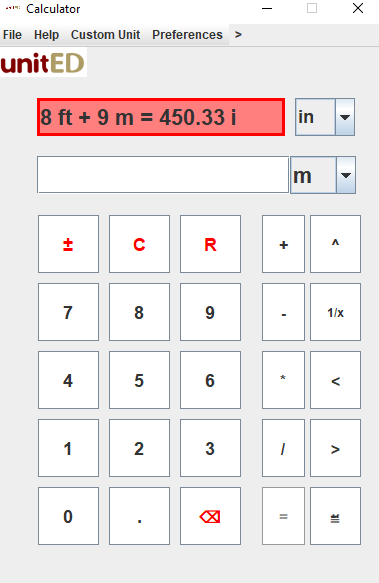
Each unit category is implemented as a Java enum that implements a common Unit
interface. Every enum constant defines a factor (its magnitude relative to the
category's base unit). Conversion between any two units in a category uses a single formula:
value * from.factor / to.factor. For example, Length uses millimeters as the base
(factor 1), so converting 1 foot (factor 304.8) to centimeters (factor 10) computes
1 * 304.8 / 10 = 30.48.
Arithmetic between unit values goes through a BinaryOperator enum that implements the
Strategy pattern: each operator (ADD, SUBTRACT, MULTIPLY,
DIVIDE) has an evaluate() method that takes two Operand
values. Operand is a Java record (an immutable value type pairing a number with its
unit) which makes operator input/output explicit and prevents accidental mutation.
Custom units are defined by the user and persisted as CSV entries. JUnit 5 tests cover all unit-to-unit conversions for four of the six unit types, organized as cross-product test cases: every unit converted to every other unit in the same category.
Most of the personal challenges came from working in a team at this scale for the first time. Three friction areas stood out.
Version control was the first: several team members were new to Git, which led to merge conflicts and lost work early on. Running a short training session helped, but merge issues surfaced throughout the project. The lesson was that Git fluency across the whole team needs to be established before the first commit, not treated as something people can figure out as they go.
Task dependencies caused stalls when upstream work slipped. If the component one person was building blocked three others, progress halted. Restructuring assignments to minimize hard dependencies and working on self-contained modules rather than features that required another feature to exist first helped significantly.
Design consistency suffered because decisions were distributed without a shared conversation. UI choices made independently resulted in an inconsistent look and feel. Design should have been a standing agenda item across sprints, not assumed to converge naturally.
Team projects have a different failure mode than solo work. Technical debt accumulates faster when design decisions are distributed without coordination. Some key takeaways:
 hunter baker