$ a recipe finder for ingredients you already have
Pantry Panic is a group web development project. It lets you build a virtual pantry of ingredients you have on hand, then searches for recipes you can actually make with them. My primary role was the backend integration. Wiring up the Spoonacular API and managing data flow between the API responses and the frontend state.
The project is currently non-functional because the Spoonacular API service was cancelled. The demo links to a personal fork.
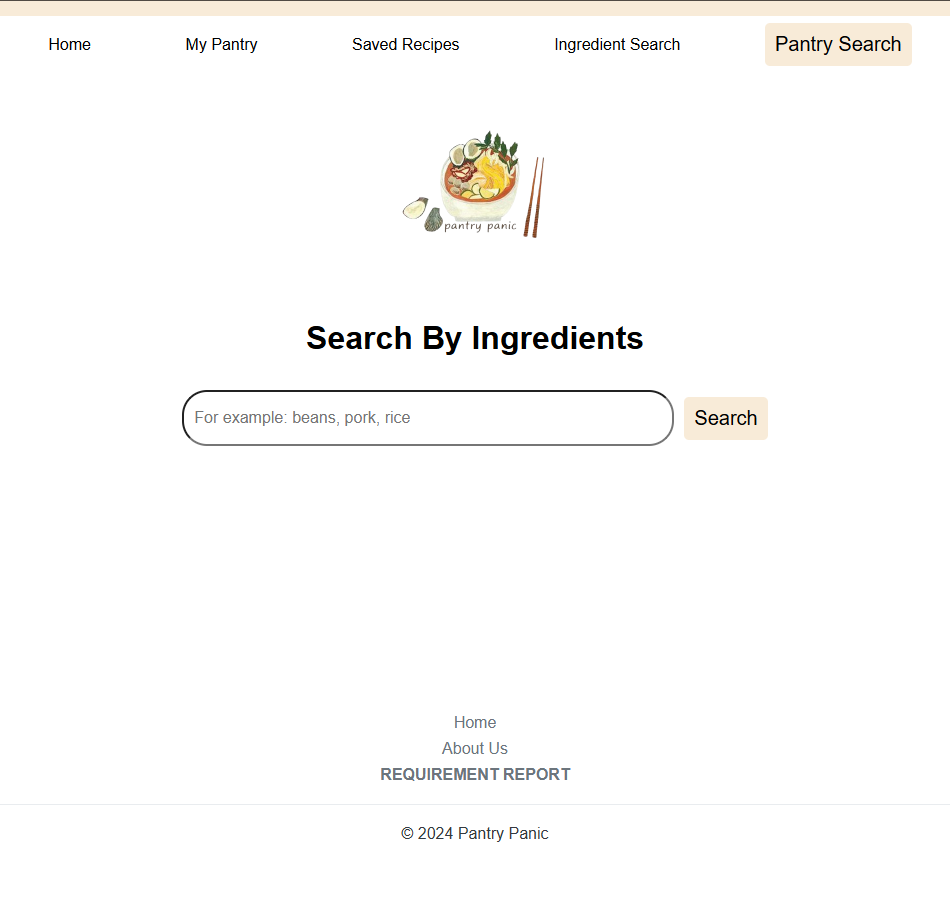
Recipe search uses a two-stage API flow. The first call hits findByIngredients with the
pantry list and returns a ranked list of matching recipes along with how many ingredients each
recipe uses vs. misses. The second call hits informationBulk with the result IDs to
fetch full recipe details (title, image, instructions, nutrition) for display.
Pantry state is stored in localStorage across three keys: 'pantry' as a CSV
string of ingredient names, 'pantryCheckboxes' as a JSON object tracking which
ingredients are checked for the current search, and 'savedRecipes' as an array of
recipe IDs the user has bookmarked. This means state survives page reloads without any server-side
storage.
The Blob API handles pantry import and export: export serializes the current pantry list to a text
file the browser downloads, and import reads an uploaded file back into state. An
APIACTIVE boolean flag at the top of the integration code disables all outbound API
calls during local development, allowing UI work without consuming API quota or requiring a live
key.
The two-stage API design was driven by Spoonacular's endpoint structure rather than preference.
findByIngredients is fast but returns minimal data; informationBulk
returns everything but requires IDs. Coordinating the two calls, handling the case where the first
returns no results, the second fails for some IDs, or the API quota is hit, required explicit error
states for each stage rather than treating the whole flow as a single operation.
Working in a group on a frontend-only codebase meant merge conflicts were frequent: everyone was editing the same HTML and CSS files. Establishing which person owned which file sections early would have prevented most of them.
First time integrating a third-party REST API. It taught a lot about the gap between reading documentation and handling production edge cases. Some key takeaways:
 hunter baker