lolsummd

$ aggregate League of Legends champion mastery across all your accounts

overview

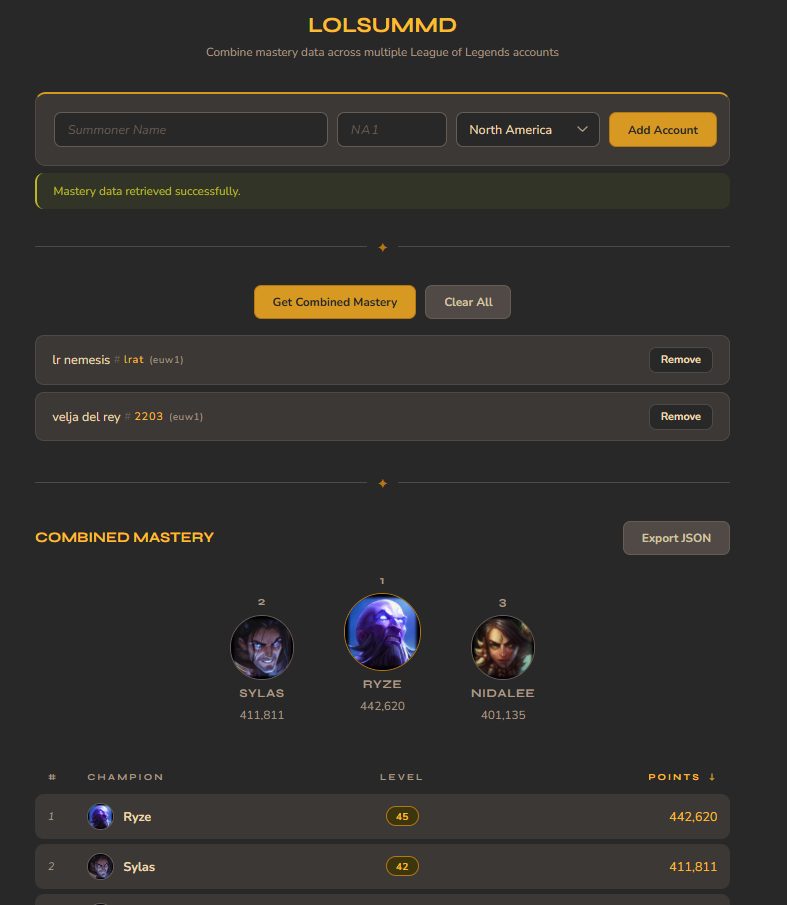
LOLSUMMD solves a specific problem for multi-account League of Legends players: champion mastery history is siloed per account, so your real total for a champion you've played across multiple accounts is invisible to the client. The app lets you add up to 10 accounts by Name#Tag, fetches mastery data for each via the Riot API, and sums points and levels per champion ID to produce a unified view.

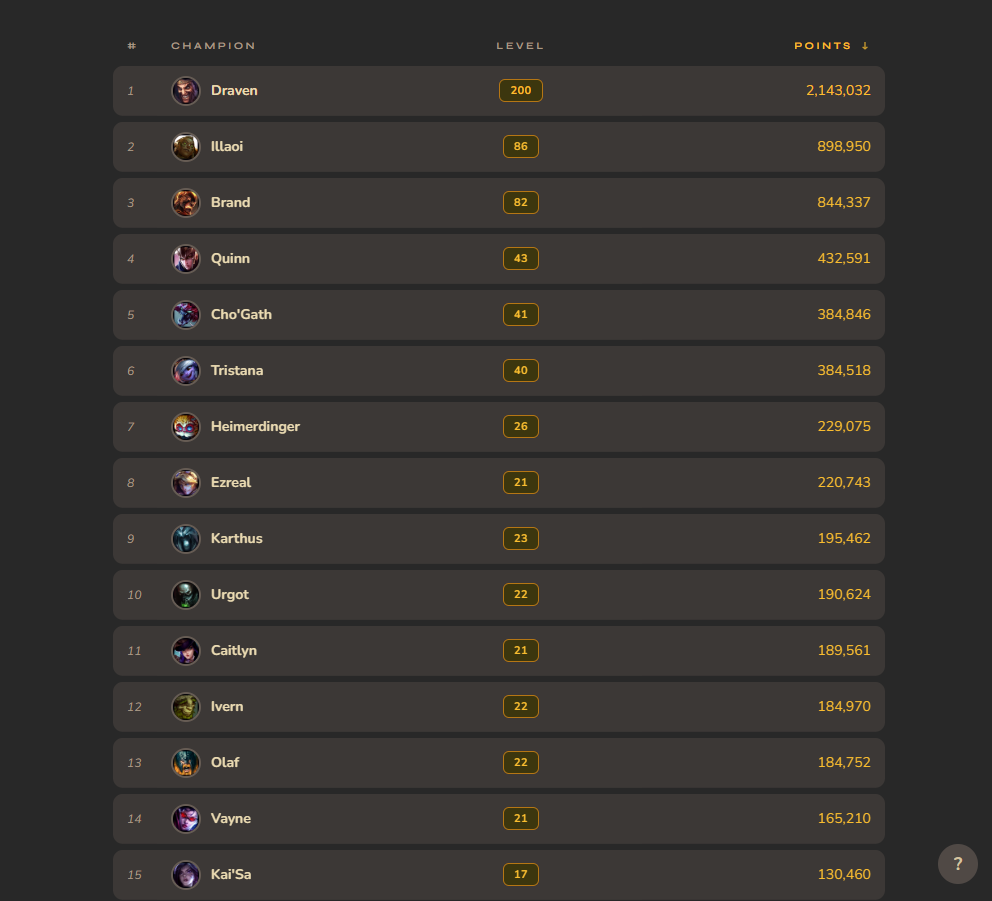
Champions can be sorted by name, total mastery points, or combined level. The top three champions are displayed in a podium widget, and the full dataset can be exported as JSON.

tech stack

  • Python, Flask: backend serving templates and handling form submissions
  • Redis via Upstash: serverless Redis for 24-hour mastery data caching with auto-indexed name lookup
  • Riot Games API: 14 regional endpoints across 4 continental platforms for summoner and mastery data
  • HTML, CSS, JavaScript: frontend
  • Vercel: serverless deployment

links

showcase

LOLSUMMD champion mastery aggregator screenshot

how it works

Account lookup uses a two-stage Riot API flow. The Name#Tag pair is resolved to a PUUID via the Account API on the appropriate continental platform, then the PUUID is used to fetch per-champion mastery records from the regional endpoint. Riot exposes 14 regional APIs across 4 continental platforms (Americas, Europe, Asia, SEA), and the app maps each region to its correct pair of endpoints.

Mastery aggregation is a straightforward reduce: iterate each account's mastery list, accumulate {champion_id: {points: N, level: N}} into a shared dictionary, and sort the result. The frontend parses clipboard paste input splitting on the # separator and submits the account list as a form POST.

API responses are cached in Redis with a 24-hour TTL. Two cache key namespaces are used: cache:accounts:{puuid} stores mastery data for a given account, and cache:name_index:{username}#{tag}#{region} stores the resolved PUUID so repeated lookups for the same summoner skip the account resolution call. Cache entries are auto-indexed on write so name-based lookups can hit the cache without re-resolving.

takeaways

Building around a rate-limited, multi-tier external API forced careful design of the caching layer and request routing from the start. Some key takeaways:

  • Multi-tier external API design, navigating regional and continental endpoint separation
  • Redis caching strategy with TTL and multi-namespace key design
  • Serverless deployment on Vercel with Flask as the backend framework