$ reverse-engineer mystery functions through a custom interpreter
The Black Box Challenge is a terminal-based coding puzzle built with a partner for CS 430. The player is presented with a hidden mystery function, they probe it by entering inputs and observing outputs, then write their own expression in a custom programming language to replicate the function's behavior. A side-by-side table shows expected vs. actual output on every run.
The project's core technical achievement is a complete interpreter pipeline built from scratch: a lexer that tokenizes source into 27 token types, a recursive descent parser enforcing 13 levels of operator precedence, a typed AST with 56 node classes, and a tree-walking evaluator. Terminal.Gui provides the live terminal UI with panels for input, code editing, and comparison output.
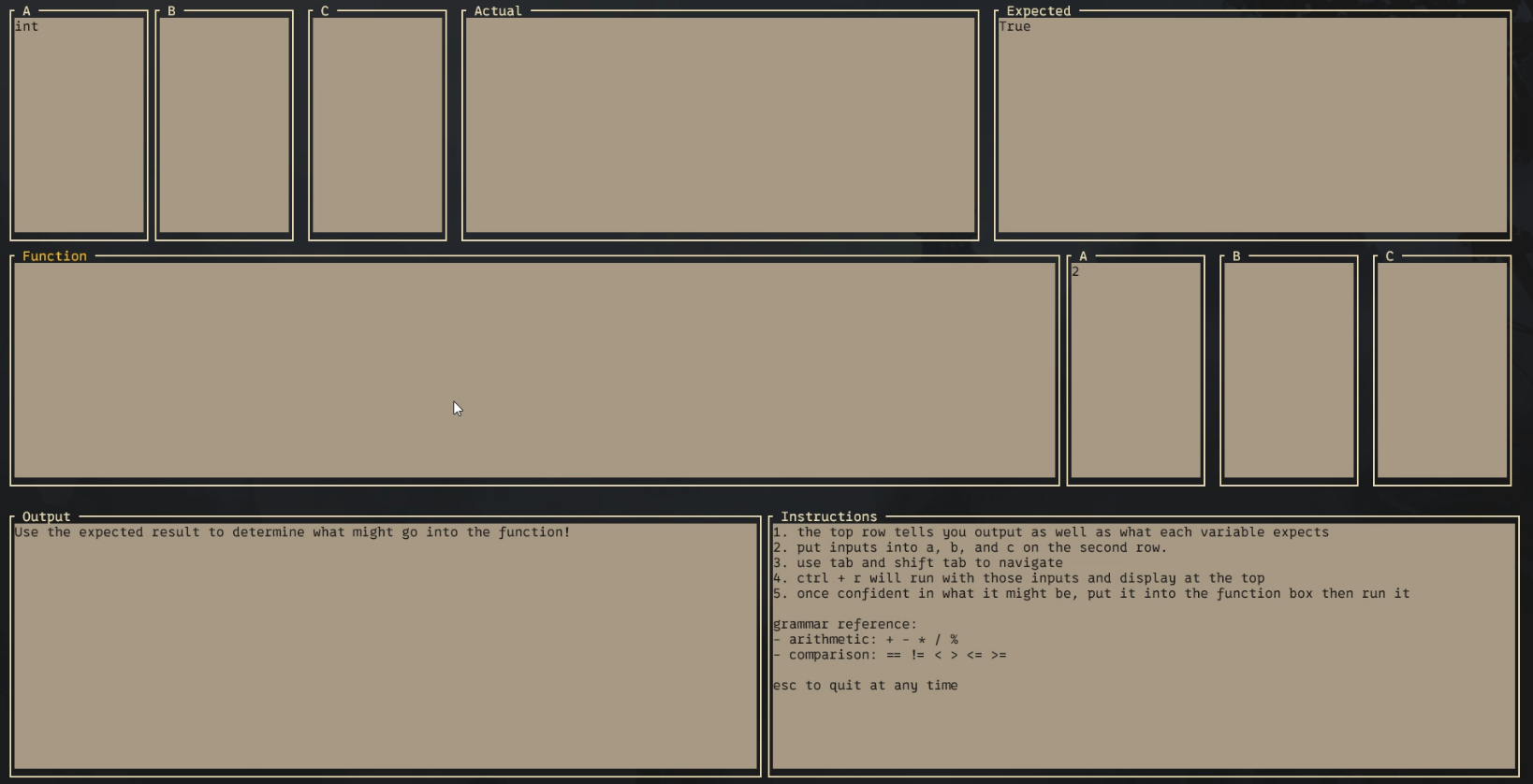
When the app launches with a mystery function number, the corresponding .txt file is
parsed into a reference AST. The UI presents input fields for up to three parameters and a code
editor where the player writes their guess.
On Ctrl+R, two parallel evaluations happen: the user's code is lexed, parsed into its own AST, and
evaluated with the entered parameter values bound as variables; the same values are fed into the
pre-parsed reference AST. Both use the same Evaluator, which implements
IVisitor<IPrimitiveNode> and walks each node recursively. The results are
compared and displayed. The language supports integer and float arithmetic, boolean logic, bitwise
operations, relational comparisons, string primitives, variables, blocks, and explicit type casts
(int(), float()). All operators enforce strict type homogeneity. For
example,
5 + 5.0 is a type error; explicit casting is required.
The most interesting design challenge was operator precedence. Rather than a runtime precedence
table, the parser uses a 13-level hierarchy of levelN() methods, where each calls the
next for higher-precedence operators. Left-associative operators loop; right-associative
exponentiation recurses right instead of left.
private IAstNode level11NonTerminal()
{
    IAstNode left = level12NonTerminal();
    if (has(TokenType.EXPONENT))
    {
        advance();
        IAstNode right = level11NonTerminal(); // recurse right, not left
        left = new ExponentNode(left, right, ...);
    }
    return left;
}
The - token required context-sensitive disambiguation: the lexer always emits
SUBTRACTION_OR_NEGATION, and the parser decides at the call site. In a unary context
it becomes NegationNode, in a binary context it becomes SubtractNode. No
backtracking required.
Short-circuit evaluation was implemented explicitly in the Evaluator: for AndNode, if
the left operand evaluates to false, the right is never visited. This required making right-side
evaluation conditional rather than eager, which the Visitor pattern made natural. Calling
.Visit(this) is deferred until needed.
Building a complete interpreter from a formal grammar illuminated how programming languages work at every layer. Some key takeaways:
 hunter baker